
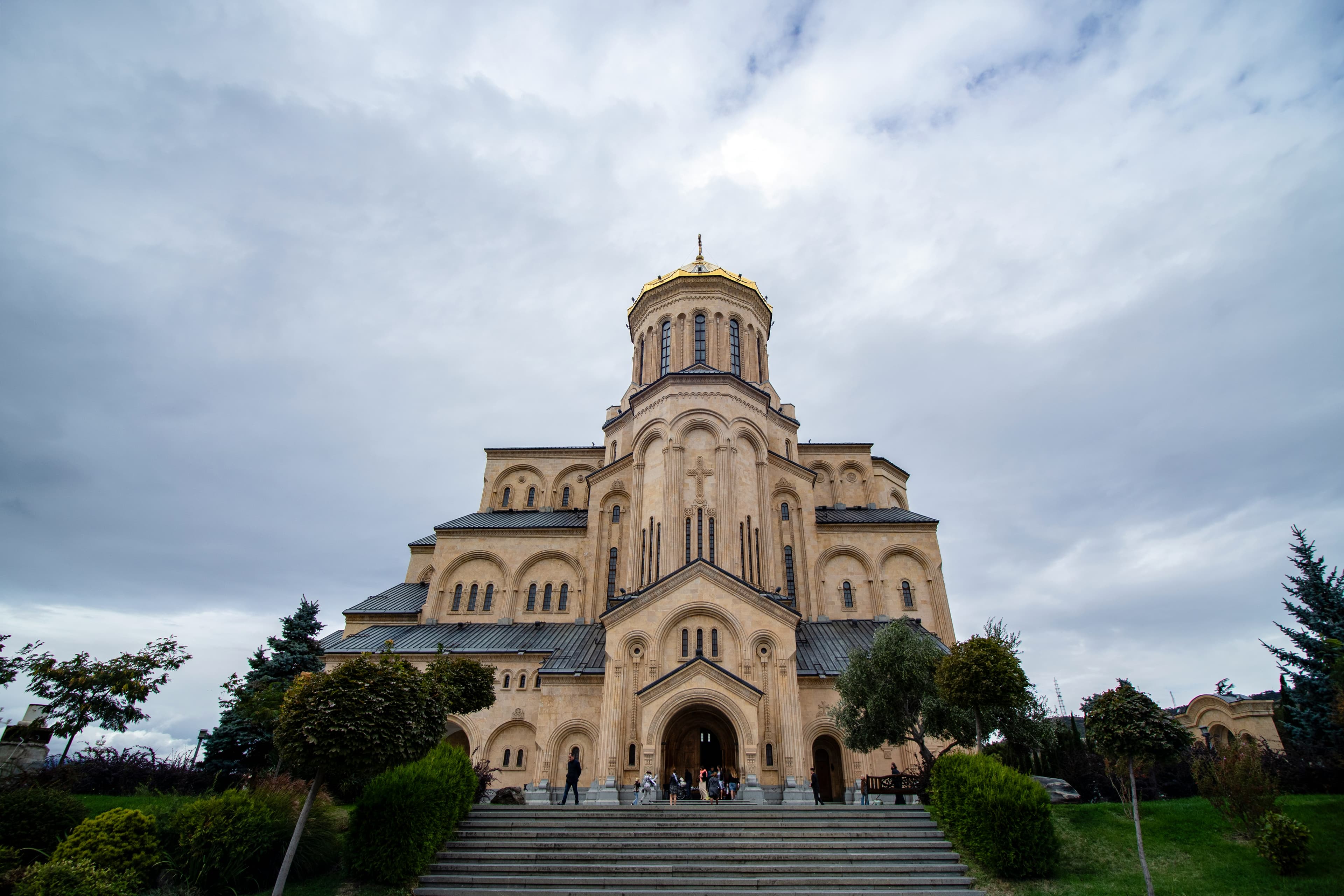
Holy Trinity Cathedral
Tbilisi
The Holy Trinity Cathedral of Tbilisi, widely known as Sameba, is one of the most significant symbols of modern Georgia. Rising above the city with its monumental golden dome, the cathedral represents the country's spiritual heritage, cultural identity, and renewed national confidence. Located on the hill of Saint Elijah on the left bank of the Mtkvari River, Sameba has become one of the most impressive landmarks of the Georgian capital.
The construction of Holy Trinity Cathedral began in 1995 with the aim of creating a symbol of the revival of the Georgian Orthodox Church and a landmark representing the new era of independent Georgia. The cathedral was officially consecrated on 23 November 2004, on the Georgian Orthodox celebration of Giorgoba (the Feast of Saint George). Its construction was dedicated to two major historical milestones the 1,500th anniversary of the restoration of the autocephaly of the Georgian Orthodox Church and the 2,000th anniversary of Christianity in Georgia.
Designed by Georgian architect Archil Mindiashvili, the cathedral is based on the principles of traditional Georgian ecclesiastical architecture while expressing the scale and ambition of the modern era. With a height of approximately 87 metres, including the cross, Sameba is one of the tallest religious buildings in Georgia and one of the largest Orthodox cathedrals in the world.
The Holy Trinity Cathedral complex extends far beyond the main church building. Its territory includes several smaller churches, a bell tower, religious and administrative buildings, gardens, and underground spaces. The interior is distinguished by its impressive scale, traditional Georgian decorative elements, and examples of contemporary iconography, making it an important centre of modern Georgian religious art.
Sameba holds significance not only as a place of worship but also as a symbol of national unity and cultural revival. Built during the period of independent Georgia, the cathedral represents the connection between the country's historical heritage, spiritual traditions, and modern identity.
The location of the cathedral creates an additional visual experience. From its courtyard, visitors can enjoy panoramic views over Tbilisi, including the historic neighbourhoods and modern districts of the city. The cathedral is especially striking in the evening, when its illuminated golden dome becomes one of the most prominent features of the Tbilisi skyline.
Visiting Holy Trinity Cathedral is more than experiencing an architectural landmark it offers an opportunity to understand contemporary Georgia, its Orthodox traditions, and the national symbol that has become an inseparable part of Tbilisi's identity.
Join our tour and discover the spiritual centre of Tbilisi explore the history, architecture, and significance of Sameba Cathedral through the stories shared by a local guide.
Back to Tbilisi